Click To Give - It's FREE !

The Animal Rescue Site
Showing posts with label dog issues. Show all posts

Friday, September 17, 2010

Ban would send shop to doghouse - what's your opinion ?


This article as hit Facebook and it’s “stirred” up a heap of furry over the sale of pets in pet shops.

Ban would send shop to doghouse

from Queensland Times newspaper ….


CLICK HERE TO READ MORE


What’s you opinion ?

Place your comment below or join us on the Gold Coast Pets facebook community.

Monday, September 13, 2010

RSCPA QLD ALERT -- Beloved pet baited - a cruel and painful death

Beloved pet baited - a cruel and painful death
by RSPCA Qld Inc. on Monday, 13 September 2010 at 15:04

RSPCA Qld is appealing for help in finding the person who baited Bronx, a nine month old Dachshund, at Jodie Court in Mermaid Waters on August 14th.

The nine month old de-sexed male was seen in the backyard eating what appeared to be mince in the early hours of the morning. Knowing that she hadn’t given this to him, Bronx’s owner ran out and found what appeared to be white powder mixed in with the mince. Within ten minutes Bronx started to convulse and was rushed to the vet. Within 40 minutes of arriving he had a further six fits and died. Bronx didn’t stand a chance.

Last Friday pathology reports handed to the RSPCA indicated that he had been poisoned with an extremely high dose of strychnine. This would also have proved fatal to a child and possibly even an adult. Humans and other animals can be poisoned by inhalation, swallowing or absorption through the eyes or mouth.

“Strychnine produces some of the most dramatic and painful symptoms of any known toxic reaction,” said RSPCA Qld Inspector Sommer Heath Crilley. “The road to eventual death is excruciating.”

Anyone with any information can contact RSPCA Qld’s Cruelty Complaints hotline on 1300 852 188.

Sunday, September 5, 2010

Gold Coast Pet and Animal Expo 2010 - Dr Chris Brown - The Bondi Vet

Dr Chris Brown
The Bondi Vet
on the outside stage at the Gold Coast Pet and Animal Expo 2010


Sunday, August 22, 2010

Legislation that affects YOU !

If you have a currently de-sexed pet, ignore this blog post as this won’t affect you. Lucky you! You’re a smart pet owner.

Gold Coast City Council LOGOGold Coast City Council has implemented a new Animal Management Legislation that requires all breeders of cats and dogs to obtain permits, and follow a Code of Practice.

The new legislation requires anybody who owns a cat or dog and intends to breed, including hobby breeders and commercial breeding establishments, to hold a current breeder permit.


Legislation that affects YOU !

click here to read more

Wednesday, August 11, 2010

Arthritis in Dogs …. What Can You Do?

AUTHOR: Dr Kevin Cruickshank


Successful arthritis treatment can do wonders for a dog’s quality

of life. Frequently the signs are simply ascribed to “old

age” and only once your dog is on treatment do you

realise how much arthritis pain was affecting them.


General stiffness, slow to get up or lie down, and slowing or dragging on walks are key signs. Arthritic dogs battle on stairs and often can no longer jump up into the car.

Best results are achieved with a combination of treatments. There are 3 major areas - Weight Loss, Controlled Exercise and Medications. Carrying excess weight makes it harder to cope, burdens the painful joints and accelerates the damage. Don’t simply try reducing what you feed – consider a specialised weight loss diet. With controlled calories and special added ingredients such as L-Carnitine and Lysine, you’ll be amazed with the results and your dog won’t be constantly hungry.

Exercising within your dogs abilities is crucial. Calculate your walks to end BEFORE the point where your dog starts to lag behind. As they improve they’ll cope with longer distances. Little and often is key. Aim to exercise daily – it’s a case of use it or loose it. Deep water swimming is an excellent exercise - it takes the weight off painful joints.

Anti-inflammatory medications will make a radical improvement. We can help you select the best brand for your dog. This is often based on the form they come in, as well as your budget. Common forms are syrup added to food, chewable tablets as well as traditional capsules or tablets.

Anti-inflammatories work both as direct pain killers, as well as by stopping the inflammation of arthritis itself – hence they actually treat the problem rather than just masking the symptoms. Additionally we can improve
the lubrication in joints, help control inflammation and change
the course of the disease with Pentosan injections. Once initiated,
some dogs may only need an injection once every 3 months.


Glucosamine is a fantastic supplement that helps control arthritis. Glucosamine works by keeping cartilage, the shock absorber of joints, healthy. It comes in many forms and it is best to look for a product that also contains Chondroitin, as well as ingredients such as MSN and Vitamin C. We prefer to use products that DO NOT come from Shark Cartilage. Green Lipped Muscle Extract is also useful. It’s a natural anti-inflammatory, and mostly comes in a powder form. Fortunately there are now several excellent Joint Diets available that include many of these supplements. Sensibly they also focus on preventing obesity. And of course the little things help too. Keep them warm in the cooler weather and provide soft, non-slip bedding.


So through a combination of weight control, tailored exercise, special joint diet and anti-inflammatories, your dog can enjoy a new lease on life and win back their mobility. Don’t let them struggle any longer – book in for an Arthritis Check today if you have any concerns about your pet's mobility.


AUTHOR: Dr Kevin
Cruickshank

Dr Kevin along with his lovely wife Fiona own Gold Coast Vet Surgery.
"Where Pets Are Family" !


Sunday, March 7, 2010

THE DOG WHISPERER CONTROVERSY

Please feel free to have a read of [ this article ]. Due to copyright, I cannot publish any part of it on my blog thus you will have to go to the article itself first.

The article is very well written, in my opinion. For those who adore Caesar Milan, it might be a good read. Times change, as does research... thus those of us who deal with dogs as owners or as professionals in any capacity should keep "on top" of these changes.

This is where using food as the drive mechanism to initiate training or behaviour modifications is the standard "go to" for most trainers. Dogs are more like water-ed down versions of wolf puppies who rely on the "alpha male and female" (who are their mum and dad).

"Power struggles with dogs communicate no more leadership than an adult human “dominating” a small child or an armed bank robber and his hostages." Lisa Mullinax, CPDT

{ read the article here }

Tuesday, February 2, 2010

Dog Dominance

Is a fact however choose to be an effective leader not a dominator. This is what your dog seeks. This is what will help you to overcome behaviour problems.

Good leaders set consistent (never arbitrary) rules and boundaries.

I will repeat:

Good leaders set consistent (never arbitrary) rules and boundaries.

This means that as soon as you are in your dog's life (whether as a puppy or adoption of an older dog) - the rules and boundaries you set forth must be followed by you not just your dog.


The shortest path to solving a behavior problem is to look at the behavior for what it is. What purpose does it serve? How is this problem behavior working for the dog? Are this dog's needs being met? What behavior would we like to see instead of the unwanted behavior?

Then we can set about making what works for the dog the same thing that works for us, like a good leader should.

-- Aidan Bindoff ( website )


Tuesday, January 5, 2010

Dogs get bored if they never leave home

I am unsure who pointed me to this article however I agree! If you do not want the expense of professional dog trainers, hire the services of someone like myself who will gladly exercise your dog(s) !

"It's too hot" is not a viable excuse: just walk them sooner or opt to have a "night" walk ! Yes, I can and will do after sunset night walks if viable.

"I cannot afford it" is also another poor excuse: can you afford the costs of a professional dog trainer to sort out the problems bored/under-exercised dogs will end up creating ? In the scheme of things, I am rather affordable.

Remember, a tired dog is a happy dog!


by Susan Sharpe and Beth Hough

Winter months are very busy for dog trainers. Previously well-behaved dogs begin chewing, jumping, barking and seem to be out of control.

Dog owners fail to make the connection between their dog's unwanted behavior and the fact they are walking them less – or not at all, because of the weather.


Sunday, December 6, 2009

Choosing the right dog for apartment living

Disclaimer: The owner of this blog is not the author of this article. The author is currently unknown. If you are the author of this article, please contact me so you can be given credit.

As a Veterinary Technician, one of the most often asked questions I get is how to choose the right dog. Without knowing your living situation, this is a hard question to answer. Today, I am going to give you a list of dogs that I feel are best for apartment living. The most important thing to think about when getting a new dog is how much time you will have to spend with it. Next is where to purchase it? I always suggest adopting from a shelter or breeder. Never buy a dog from a pet store because, they get their puppies from Puppy mills. You need to research the breeds that have the best temperament for your needs. If you have children, it’s important to get a dog that will be good around them. After that, you need to consider health issues for certain breeds, and the cost of Vet care. I would urge you to look into mix breeds as well. Just because it’s not a pure breed does not mean they will not make a good dog. The following dogs are my picks that do well in an apartment setting.


  1. Japanese Chin

These dogs are ideal for apartment living. Japanese Chins are gentle, friendly, and obedient. They have no odor, rarely bark and love to be held. Full grown Chins weigh 7 pounds.


  1. Shih Tzu

This beautiful dog is quiet, easy going, very trusting, great with kids and needs minimal exercise. They weigh 16 pounds fully grown. Require weekly brushing.


  1. Pekingese

Their small size makes them a good choose for apartment life. They do not require a yard and need minimal exercise. Pekingese are intelligent, good natured and opinionated. May not be the best dog around small children. They also need weekly brushing.


  1. Chihuahua

These little guys are perfect for living in small quarters. Chihuahua’s are protective, confident, brave, curious, playful and not good for small children. They only weigh 4 pounds fully grown.


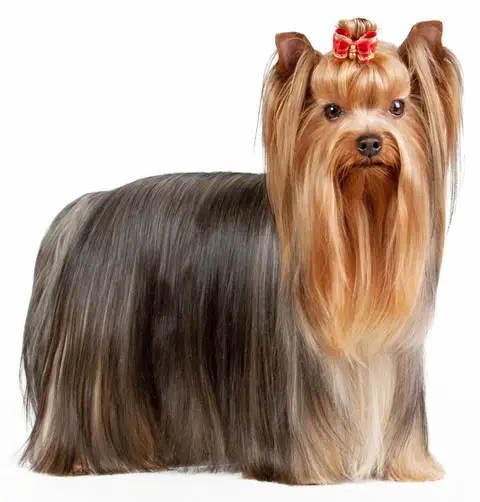
  1. Yorkshire Terrier

These darlings don’t require a lot of exercise. They are intelligent, assertive, make good watch dogs, travel well, and have a big personality in a small package. A full grown Yorki weighs 7 pounds.


  1. Boston Terrier

Known as the American gentleman, these dogs make incomparable companions. They can be mischievous, affectionate, good with other dogs, and great with kids. They only need moderate exercise and require minimal grooming. Only get 24 pounds fully grown.


  1. Pug

Pugs are big eaters and are said to be a lot of dog in a small space. They adapt easily, are great family dogs, even tempered, and outgoing, with a loving disposition. They do shed but require little grooming and posses a great charm.


  1. Miniature Schnauzer

Always willing to please, these dogs do love to bark and be a watch dog. They are fearless, alert, intelligent, strong and quick to learn. They are obedient and easy to maintain. At fully grown they get to be 18 pounds.


Thursday, November 19, 2009

Worldwide Internet Puppy Scams


Please contact me asap if you are aware of someone
fraudulently using Gold Coast Pet Sitting name and/or logo.

From Dogmovers

… the world wide web .. i.e., the internet .. provides potential pet owners with a wide variety of information as well as the chance to purchase a pet and/or adopt a pet.

… we recently have been made aware of off-shore based companies purporting to be affiliated with various Pet transport businesses including our own as either agents, or partners.

Dogmovers is based on the Gold Coast in Australia, We have only one office in Australia and are not involved with international transport of pets of any kind. We transport pets only within the states of NSW & QLD in Australia and we only transport pets by Road. Never by Air.

We have no partners or affiliates anywhere. We do work closely with several local pet transport businesses however it is normal for us to contact all parties directly by phone to finalise any arrangements concerning bookings with us. We do not usually finalise any details via email.

Additionally in most cases payment for our services is made directly to our driver at the point where he picks up or drops off your pet, In the event that a client chooses to pay via credit card or internet Banking the details are relayed directly from us by phone. We do not hold bank accounts outside of Australia.

At this point we are aware of instances of our name and logo being used in relation to scams in North America as well as the names ANIMAL MOVERS CO LTD & Animal movers pet carriers & Air animal pet movers being used in Australia. In all of the instances we are aware of the pets concerned were British bulldog pups, being given away. All monies requested were for transport or vet services prior to travel.

… the common business profile of the off-shore based company is to have you transfer several hundred dollars to their off-shore locations …. Once they “set the hook” into you with your initial deposit .. .. they come back with a sense of urgency …. indicating there are additional funds required to have veterinarians conduct “tests” before the pet is released to you … and then request generally an additional USD$150.00 …. As you review their e mails to you …always with a sense of urgency directed towards you .. the unsuspecting consumer … you will observe frequent errors in spelling and significant errors in sentence structure.

… another identifier of the off-shore based company is their reluctance to provide you with flight details, airline schedules, and air cargo air way bill tracking numbers … the off-shore based company will only provide you with information after you have wired them additional funds.

If you have any doubts check out the companies website. If they are using the name Dogmovers and after reading the above you are still not sure, call us on (07) 5530 2710 and don't pay the money.

The following is a copy from an email distributed recently which i believe is linked to the current scam (we received this twice)...

Hi,

I am looking to place a litter of 5 adorable bulldog puppies and also the parents, they belong to my late mother in law who I was really close to and she passed away unexpectedly, she is so much in love with the bulldog breed, that she breeds only once a year for the love of the breed. My husband and I recently moved to a new apartment where pets are not allowed. I want to find these lovely puppies and the adults a permanent loving and caring homes, if you are interested in having them, please contact me immediately.

Have a nice day.

Jessica

If you wish to report a scam you can contact the following Queensland links or locate similar organisations in your own state.

Queensland Police Computer Crime Investigation Unit

External email - cciu@bigpond.com.au
Telephone - 61 7 3364 6943 or 61 7 3364 4113
Facsimile - 61 7 3364 6549

Brisbane Office of Fair Trading
Email: BrisbaneOFT@dtftwid.qld.gov.au
Level 21, State Law Building, 50 Ann Street, Brisbane
GPO Box 3111, Brisbane, QLD, 4001
Facsimile: (07) 3246 1589

Nationally, Scamwatch is part of the ACCC

http://www.scamwatch.gov.au/content/index.phtml/itemId/694011

If you have any other info that you think I should ad to the above let me know. I can be contacted by email at info@dogmovers.com.au

David Gallagher,

Dogmovers { SOURCE }


Sunday, November 8, 2009

How Much Exercise Does My Dog Need?


Not all dogs require the same amount of exercise. In considering this question, we also must expand our “human” concept of exercise. Dog exercise comes in a variety of forms not regularly practiced by people.


Exercise needs have very little to do with size. Instead the breed of your dog tends to count the most. For example Jack Russell Terriers and Shelties often begin to misbehave when given too few dog exercise opportunities. On the other hand, a mastiff, and many other large dogs may be happy with a couple of daily walks in the park or a 15 minute game of catch the ball.


Little dogs quite frequently require more exercise than larger dogs. Many exercise needs for small dogs can be satisfied in an apartment or back yard. If the small dog has adequate toys, or a dog or cat companion, the dog can generally meet all its exercise needs. However, don’t miss walking the dog on a daily basis too; a walk proves healthy exercise for both the dog and its owner.


Mid-size breeds also vary in their need for exercise. Expect dogs that are natural hunters or herders to require more exercise. Beagles, hounds, border collies, Alaskan sled dogs, and Australian shepherds are naturally going to be restless if cooped up. They need time to run around, catch things, chase things, and to walk or jog.


Many of the working dogs benefit from having another dog companion. They also will benefit from visits to dog parks. A thirty minute to one hour visit to a dog park each day frequently gives the dog as much exercise as he needs because playing with other dogs requires exertion. Also expect to walk or jog with these dogs daily.


Some dogs also require mental exercise. Dogs, like people, can get bored. Certain dogs get bored enough to engage in undesirable behaviors like destroying potted plants or eating your shoes and furniture. New toys that require some work to get reward are fantastic for dogs that need a mental challenge. Also, daily interaction with your dog will help satisfy some mental exercise needs.


Since many dogs are mixed breeds, it may be hard to know what type of exercise requirements a dog has. Once you get a mixed breed dog observe its behavior. If the dog enjoys basking in the sun most of the day, it probably does not need as much exercise. Conversely, if the dog appears restless and wanders around the house or yard relentlessly, its needs may be better met by more exercise. Also, older dogs tend to have less daily exercise needs than do younger dogs.


As with people, be wary of providing too much exercise in hot temperatures. During hot months, allow your dog to take breaks and bring along water. Also choose exercise periods from the coolest parts of the day, like right before sunrise or right after sunset.


Written by Tricia Ellis-Christensen

Wednesday, October 14, 2009

Triangle of Temptation


This is a behaviour, pack structure & obedience program that takes nearly no time from your day. I created this program after many years of working with dogs.


This is the basic/generic version of the program, I modify it slightly with the same basic technique to solve problems & go into advanced learning.


It's remarkably effective for gaining control with no force. I have used it with dogs for many years that have been trained to engage a man in combat & would not hesitate to attack me if it were not for this program. I have also used it to rehab extremely fearful dogs that would otherwise not even look at me.


It's also the basis of the bonding program I specify to all my clients…


The bases of this program is to have the dog look to you for guidance & permission to partake in anything you say that the dog can, including food, toys, game etc. Our goal is to have the dog engage self control out of respect for you. This teaches the dog to control its drive & strengthen its mind.


To begin the program we must follow basic training principles, they are the learning phase, the correction phase & the distraction phase.


This means start the training with no other distractions around, no dogs people etc.


The key to starting is to have a food driven dog, if you don't have a dog with a high food drive, miss the meal before you start or at least reduce it by ¾. Fasting is healthy for dogs.


Now you have a dog that wants the food, this means the dog will have drive for the food.

This is a training IN drive program.

Training in drive uses the drive concept that "drive is a subconscious reaction to stimuli", this program works fast on any dog.


Next back tie your dog with a flat buckle collar (non correctional collar) & rope to something solid in your yard. Make sure all other dogs are out of site, we are looking for as low a distraction as possible. Learning is best done under no distraction; we are trying to trigger food drive, not possessiveness, so no other animals.


Prepare the meal inside & this should be done after all higher members have eaten. Your dog will learn, through positive results in this program that being tied out will end in drive satisfaction ie: Positive reinforcement. This is good if you have a dog that whines on a tie out.


At the end of the program you will have a list of things, such as being tied out, long sit stays etc that are all thought of as positive to your dog.


Allow your dog to relax on the back tie, a few minutes is usually enough. Don't go out to a whining dog.


Now bring out your dogs food, show it to your dog, & begin to walk out in front of your dog, your looking for that moment in distance that your dog looks like the food wasn't for him or her after all. Basically taking the dog just out of full food drive.


Your trying to trigger the dogs' high food drives but not so high as to make self control impossible, this would be called drive peak. This distance for some dogs is 2 metres, other 10 metres.


Now you will find our dog looking at the food, possibly trying to get to it, this is what you want.


If the dog is going to hysterics, move the food further away. (This would be an example of full food drive peak)


What it shows is that the dog thinks that he is entitled to the food, but that's not the case.


Approach your dog & stand at his right hand side, stand quietly whilst the dog gets all excited for the food. Look at your dog & wait. Say nothing.


One of two things will happen, either the dog will go on & on & just stare at the food or he will look at you.


If he doesn't look, say the dogs name. You want to see the dog look at you, when he/she does be quick to "mark" the look with "yes" then release the dog with an OK (free) command & let the dog loose to eat the food, you should sound very happy.


Many people tell me they already do most of this, do it exactly as described. Missing the verbal marker & the free command will change the outcome…


The next evening you will repeat the same. This exercise is very effective, as you need to feed your dogs anyway, so they may as well learn at the same time.


You are looking to repeat this until when you place the food down, the dog looks at you & not the food. I can have most dogs do this in 2 – 4 days. The dog does not need to give you total attention unless you're looking for competition level results.


Looking at you means the dog sees you as the person in charge; he has given up staring at the food as he knows that it's you who say when he can have it, & he can only have it when you say so.


Now its time to add the sit command when you stand next to the dog. As soon as the dog sits, you verbal mark with yes.


Bend down & unleash the dog, give OK command so the dog may eat. Always go inside when you release the dog. Dont allow the leash to steal your respect.... Make sure the dog only releases when the "ok" command is given, not the snap of the leash...


The triangle is formed by drawing a line between you, the dog & the temptation.


When you have a good sit, as that is what is being built here, you can add time, by saying stay & then verbal mark yes after 10 seconds, then 60 seconds & so on.


Remove the back tie & keep it in your hands, if the dog should break the stay, you begin again.


Your looking to increase the time the dog has to stay sitting by reasonable increments per day until you get over three minutes. This is all standing right next to your dog. Think of the achievement so far, your dog will tie out happily; it will sit, stay & give you attention, all in the presence of food.


When three minutes has been gained & you will be certain you can go farther, start to increase the distance between you & the dog, whilst holding the tie out rope.


You should increase this distance by increments of 1 - 2 metres.


Up until you did this, the dog was viewing the food (temptation) as unobtainable, & you as unbeatable.


Now by increasing the distance the dog will start to feel the food is obtainable & you just might be beatable.


The long rope will teach the dog very quickly that you are not.


The rule you need to remember is:

Time before distance before distraction.


This is essential for a marked improvement every day.


When you find yourself able to wander inside while the food bowl sits there UN touched by the dog, you're ready to add distraction.


Allow a second dog now to eat from its own bowl perhaps, remain out of site for a period of time, and change the environment to outside the front gate perhaps. These are just some ways to add distraction.


Build reliability into your dog by working it.


When you're at this level you will never have a dominance problem with your dog, you can't have, he looks at you to make the big decisions, like when he can have his treasure.


Feel free to substitute the food for another treasure, such as a treat, ball, toy or an open back door or front gate.


The key is that this gives you control of all the treasures in life, each repetition is positively rewarded at the end by allowing the dog the treasure, when you say he can have it.


This is the generic version of this program, we modify this program many ways to suit different applications, from nervy stressful dogs to rank aggressive dogs to high level competitors.


I use a prey item in the TOT to teach bite work, comp heeling etc etc…


The power words your dog learns are yes & ok, these should translate into the teaching & training of every commend you teach your dog…


We can tailor this program to suit all applications.


This article is copyright protected (2000) © and can not be used or distributed without K9 force consent. You are, however, allowed to distribute this link to direct people to this site.


Steve Courtney

K9 Force Professional Dog Training & Behaviour Consultancy.
Accredited Dog Behaviour Consultant.
Accredited Dog Obedience Trainer.
Accredited Law Enforcement Dog Trainer.

Monday, October 12, 2009

Worried about leaving your dog in your car ?

Worry no more !!!

If you have an appointment of some sort (hospital, lunch, whatever!) .. bring along your dog ! It will be my pleasure to keep your dog company, hydrated and give it some exercise whilst you tend to your business.

Just provide me a water bowl, 2 litres of cold water, some of the dog's favourite treats and some doggie bags (for their poop) in a green shopping bag... and we are all set!

Naturally, a good strong collar and lead (or whatever the dog is used to being walked with) should automatically come with the dog. I will not take the dog off leash unless it is acceptable to do so (ie an off leash park is near by).

Cost?

$22 (without GST) for a single 45 minute “adventure”
$30 (without GST) for a single 60 minute “adventure”
$60 (without GST) for a single 120 minute “adventure”


Contact Gold Coast Pet Sitting for further information.


Visit my website for Gold Coast Pet Sitting, Dog Walking and House Sitting.